
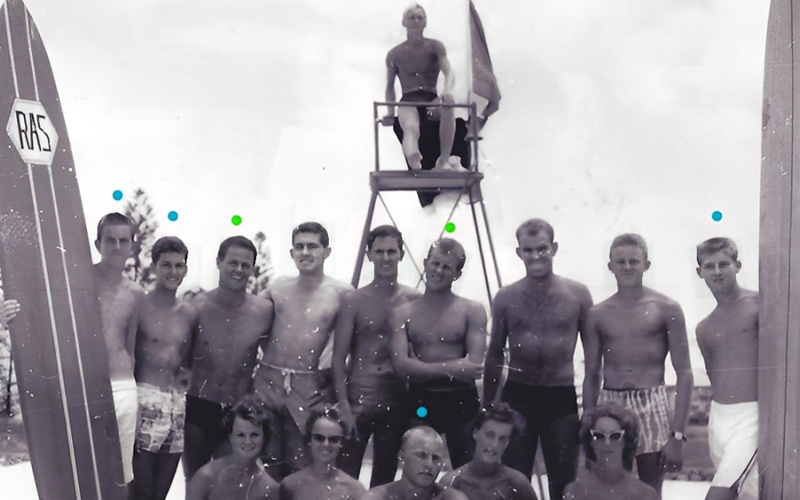
CELEBRATING 65 YEARS on Queensland Day – June 6, 2025
The 65th reunion of Coolangatta Surf Life Saving Club’s First Bronze Squad is an extraordinary occasion to reflect on our Club’s remarkable journey. From its inception in 1959 to the present day, the Club has been defined by the dedication of its members, the support of families, and enduring friendships that have stood the test of time. The memories and experiences collected over the decades truly highlight what an incredible journey this has been.
The Beginnings: 1958–1960
Our story began in 1958 at Tweed Heads Coolangatta SLSC, where a new Bronze Squad was formed under the guidance of Instructor Bill Sullivan. Bill, a long-serving member from a respected local family, was then an apprentice electrician with SEAQ in Brisbane and later became the owner and developer of Pioneer Country in Tweed Heads.
My own journey started when I met Trevor Isbel, a fourth-year apprentice electrician at SEAQ and a member of TH&C. Trevor introduced me to Barry Munsie, his family, and Bill Sullivan, who was also a third-year apprentice at SEAQ. Barry joined as a first-year apprentice as I began my second year.
Bill recruited his schoolmate from Coolangatta, Don Sands—whose family owned “Sands Bakery” in Tweed Heads—as well as Norman Barnes and Peter Wilkie from Brisbane, and Peter Moore, a local from Murwillumbah.
Early Training and Challenges
After completing our application forms and entrance swim test—a demanding 400-yard swim in a beach lagoon at Greenmount Beach under Chief Instructor Mr. Jack Carlin—we embarked on rigorous beach training every weekend. Mr. Carlin marked out the swim distance with beach sticks and timed us with a stopwatch, instructing, “Right boys, 8 laps under 8 minutes, please.”
At that time, the only swimming baths in Coolangatta was Jack Evans Porpoise Pool at Snapper Rocks, which was often unavailable for public swimming due to live shows. With most of us based in Brisbane except Peter Moore, our weekly training—including swim practice, Reel line and belt drills, and Rescue & Resuscitation techniques at the historic Spring Hill municipal baths, a 25-yard pool built in 1886 and still operating today.
Formation of the Club
An earlier group had formed Coolangatta SLSC and affiliated with the Point Danger Branch (PDB) on February 28, 1959. However, Club Captain Ron Westerlund struggled to recruit enough members for the 1959/60 season. A solution emerged when three senior members—Ron Bonnell, Bill Avery, and Brian Manson from TH&C—offered their support and approached our bronze examination-ready squad to join the new club.
A pivotal meeting took place on the beachfront in front of the Coolangatta Hotel, where Ron explained the challenges facing the club. We readily agreed to join, setting the stage for what was to become a lasting legacy.
Key Milestones: 1959–1960
- AGM and election of new officers for the New Coolangatta Club: 4 PM, December 19, 1959
- PDB Branch Monthly Meeting: Approval of the “New” Coolangatta SLSC’s application on the evening of December 19, 1959
- Point Danger Branch Annual Report: Official recognition of the New Coolangatta Club’s affiliation in December 1959
- First Bronze Squad passed their Preliminary Bronze Test: Sunday, December 20, 1959
- Bronze Squad sat for their Bronze Award: Sunday, January 2, 1960
- First official patrol conducted: Sunday, December 20, 1959, and on Christmas Day, December 25, 1959 (noting some confusion about the exact first date)
This marked the beginning of continuous patrols on Coolangatta Beach, a tradition that has continued for over 65 years.
Significant Community Events in 1959 and Beyond
- SLS Queensland reached its 115th year of service in 2025
- Point Danger Branch celebrated its centenary in the 2024/25 season
- The first public demonstration of the new expired air resuscitation technique in Queensland was televised on ABC Channel 2 on December 13, 1959, and adopted in the 1960/61 season
- Queensland celebrates its 165th year on June 6, 2025 (Queensland Day), having marked its centenary in the Club’s foundation year of 1959
- The Cooktown Orchid was designated Queensland’s floral emblem on this centenary
- On June 6, 1859, Queen Victoria signed the letters patent, granting Queensland status as a separate colony from New South Wales
- The Queensland flag was officially adopted on November 29, 1876
- The town of the South Coast was renamed the Gold Coast and proclaimed a city in 1959
- The first high-rise building on the Gold Coast, “Kinkabool,” was completed in Surfers Paradise in 1959 and became a prominent landmark for early surf patrols on Coolangatta beach.
Club Development and Growth
Looking back, the Club’s early years were marked by very modest conditions. Initially, members used the new President’s home garage, nearly 2 km from the beach, for accommodation. The Hotel Coolangatta provided a garage for patrol equipment, and, with the support of the Gold Coast City Council and local aldermen, a site was secured in Goodwin Park. The construction of a temporary accommodation shed with 40 bunks represented a major step forward for the Club’s growing membership and readiness for the first full season in 1960/61.
This temporary facility served members well until the approval and construction of a beachside clubhouse by the Gold Coast City Council. Construction began in 1965, and the new clubhouse officially opened in February 1966.
Major Events in the First Ten Years
- Hosting Her Majesty Queen Elizabeth II for the Royal Visit “Surf Life Saving Carnival,” Coolangatta Beach, March 7, 1963
- Grand opening of the “New” clubhouse on Marine Parade by the Hon. GFR Nicklin, Premier of Queensland, on Sunday, February 13, 1966
- Hosting the Australian Surf Life Saving titles during Easter 1966
Reflections
As we celebrate 65 years of Coolangatta SLSC, it is a fitting time to Honor the development and achievements of our Surf Club. Over this period, countless members, families, and friendships have contributed to the Club’s enduring legacy. The memories and experiences shared by all are a testament to what an incredible journey it has been.
James Purdon
Foundation Member
Life Member
Past President